Cash Arrows
StatusWorldCasual
4.4617.00 Reviews
- Version
- 1.0.1.0
- Installs
- 5.00M
- Age Rating
- Mature 17+
Screenshots
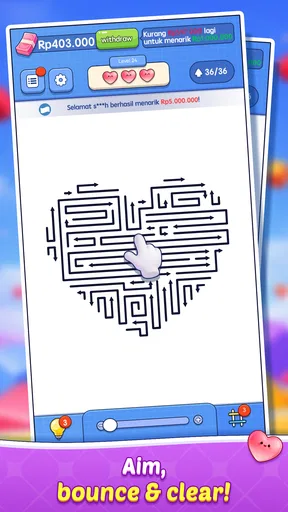
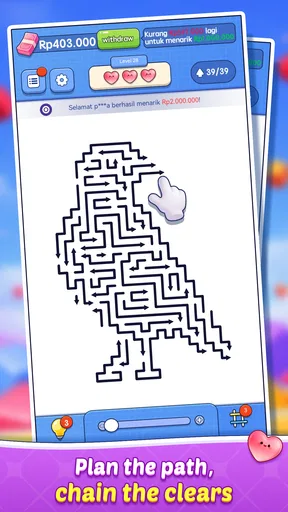
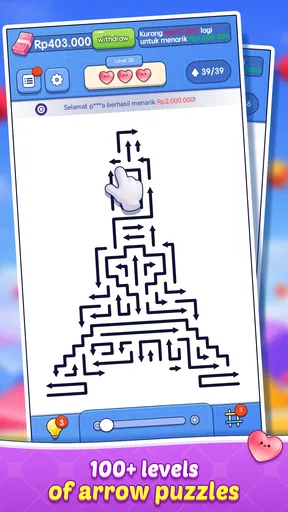
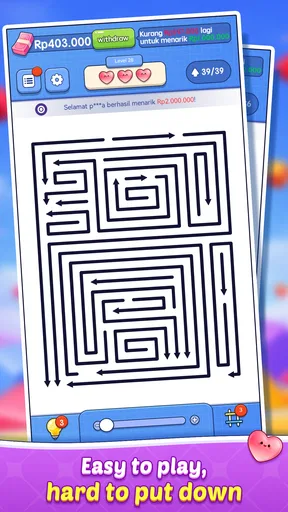

Our Review of Cash Arrows
 Analysis by Appyee
I spent time with Cash Arrows, a casual puzzle game from StatusWorld, and it quickly showed me why a simple idea can be difficult to put down. The play is built around bouncing, aiming, and clearing arrows, but the appeal is not just the first few easy moves. The interesting part comes from planning a shot, watching the rebound, and deciding whether a quick solution is actually safer than a more carefully arranged one.
It is free to play and aimed at mature players aged 17 and over. That age label is worth noticing before installing it, especially if you are choosing games for a shared family device. On compatible Android phones and tablets, it requires Android 7.0 or later. The current release is version 1.0.1.0, so I see it as an early version of a game with a clear foundation rather than a long-established puzzle platform with years of accumulated systems.
How Cash Arrows feels in everyday play
The basic loop is easy to understand: position your aim, send the shot into the play area, and try to remove every arrow. The satisfying moment comes when one move creates a useful chain of movement instead of merely clearing a single target. That makes each attempt feel more deliberate than a typical tap-to-match game, even though the controls remain approachable.
I found it especially suitable for short sessions. A few rounds fit naturally into a coffee break, a wait for public transport, or the final few minutes before bed. It does not demand the kind of uninterrupted attention I would give to a story-driven game, but it still gives me enough to think about that the session feels like play rather than empty scrolling.
The strongest quality is the relationship between aim and consequence. A careless bounce can leave an awkward arrow in place, while a better angle can open the board and make the rest of the puzzle much easier. That creates a useful rhythm: observe first, act second, then learn from the result. Players who enjoy visual problem-solving will probably appreciate that rhythm more than people looking for constant action.
There is also a nice difference between knowing what to do and executing it cleanly. I may understand that a particular arrow needs to be cleared first, yet still choose a poor angle. That small gap between intention and result gives the game its replay value. It encourages me to slow down without turning every move into a complicated calculation.
A good fit for short, focused breaks
One realistic use case is a busy workday. If I have ten minutes between tasks, a puzzle like this is easier to start and stop than a game that depends on a long mission or a team match. I can play a little, put the phone down, and return later without needing to remember a plot, a map, or a complicated set of objectives.
That convenience does not mean it is mindless. In fact, I would avoid opening it when I need to preserve every bit of concentration for work or study. The game is light in presentation, but aiming and rebound planning still require attention. It works best as a small mental reset, not as background entertainment while I am doing something else.
It also suits players who enjoy improving their own decisions. Someone who wants a deep competitive ladder, a large collection system, or a lengthy campaign may find the experience too narrow. Cash Arrows is more appealing when the pleasure comes from solving the immediate board and recognizing a better route on the next attempt.
What the current version tells me
Version 1.0.1.0 gives the game a defined starting point. I would not judge it by the standards of a mature puzzle series packed with years of refinements, because its identity is currently concentrated in the arrow-clearing mechanic. That focus is a strength: the central action is easy to grasp and does not get buried under menus or unrelated distractions.
At the same time, an early version places more weight on the quality of the core loop. If that loop clicks with you, the simplicity feels clean. If it does not, there are fewer surrounding systems to pull you back in. My advice is to decide based on whether aiming, bouncing, and clearing feel satisfying in their own right rather than expecting a broad collection of modes.
The release date is June 15, 2026, which gives useful context when considering the game’s current shape. I would treat future additions as possibilities to watch rather than promises. New puzzle structures, more varied challenges, or better tools for tracking progress could expand the experience, but I would not install it on the assumption that any particular feature is already present.
Why the simple mechanic has more depth than it first appears
My first practical tip is to resist firing immediately. The most obvious target is not always the best first target. Look for the arrow whose removal changes the available angles or opens a path toward several others. Clearing one piece can be less valuable than creating a position from which the next shot becomes predictable.
A second useful habit is to treat rebounds as part of the plan, not as an accidental bonus. Before tapping, imagine where the shot will travel after the first contact. This is where the game separates itself from very basic casual puzzles: the board rewards thinking about the second consequence of a move, not just the first impact.
My third tip is to use failed attempts as information instead of immediately repeating the same action. If an arrow survives in an awkward location, ask whether the problem was the target, the angle, or the order of removal. That small review makes the next attempt more controlled and prevents the game from becoming a cycle of random taps.
A fourth trade-off is speed versus certainty. Fast play feels lively, but it can waste a promising position. Slow play improves accuracy, yet overthinking a straightforward shot can make a short casual session feel heavier than it needs to be. I get the best results by taking time on the opening move and then speeding up once the board has become more open.
How it compares with familiar casual puzzle choices
Compared with match-three games, Cash Arrows feels more spatial and less dependent on spotting color combinations. The key question is not which group can be removed immediately, but how movement and direction will shape the next few actions. If you prefer arranging tiles and creating large visual cascades, a match-three alternative may offer more variety. If you prefer angles and controlled sequences, this game has the stronger appeal.
It is also different from endless runners and reflex games. Those usually reward rapid reactions and repeated movement, while this one gives me more value when I pause to inspect the board. Players who want constant speed may find the pacing restrained. Players who like a quiet puzzle that still asks for precision may find it more comfortable than an action-heavy option.
Against traditional logic puzzles, the arrow mechanic feels more immediate. I do not need to learn a large rule set before making a move. The compromise is that the experience may not satisfy someone seeking elaborate deduction, lengthy written clues, or a puzzle that can be studied for a long time before the first action. Its challenge is visual, practical, and compact.
That comparison also explains who should skip it. I would look elsewhere if my priority were multiplayer competition, a story campaign, extensive customization, or a large range of unrelated activities. I would also skip it if I dislike repeating a board to improve the order and angle of my moves. The game’s satisfaction comes from refining decisions, not from constant novelty.
What existing players should expect from the release
For someone already playing, the current version is best understood as a focused continuation of the same central idea rather than a reason to expect a completely different game. The confirmed release information supports judging what is available now, while future development remains something to observe. I would pay attention to whether later updates deepen the arrow puzzles without making the interface or progression unnecessarily complicated.
Players returning after a break should give themselves a few rounds to recover the feel of the aiming system. The most useful adjustment is not memorizing a particular sequence, but rebuilding the habit of checking the board before acting. Once that returns, the game’s short-session design makes it easy to settle back in.
New users may wonder whether the free price makes it suitable for a quick trial. In my view, yes, provided the core mechanic sounds appealing and the mature age rating fits your situation. The free entry removes the need to commit money before discovering whether the bounce-and-clear loop works for you, but it does not guarantee that every player will enjoy the focused format.
The game has already attracted more than five million installs and holds an average rating of 4.4 from around two hundred three thousand ratings. Those figures suggest that the central concept has found a substantial audience, although popularity does not replace personal fit. I would still use the first few sessions to decide whether the pacing and aiming feel rewarding on my own device.
Where the experience still feels limited
The biggest limitation is the narrowness of the main idea. Focus can be refreshing, but it also means the game has less protection against repetition. If the pleasure of clearing arrows fades for you, there may not be enough unrelated content to change the mood. I would therefore recommend it more confidently to puzzle fans than to people who need frequent shifts in genre or presentation.
Another point is the learning curve created by precision. The rules are simple, but a simple rule does not always mean a simple result. A slightly different aim can produce a very different outcome, and players who prefer forgiving controls may find that frustrating. The game rewards patience, so it is not the best choice for someone who wants every move to succeed on the first try.
The mature rating also narrows its audience. Even if the gameplay looks like a casual puzzle, the stated age classification means I would not treat it as an automatic recommendation for children. Adults should make that check before installing it on a family tablet or handing over a phone.
Finally, the early version matters when setting expectations. I like the clarity of a game that knows its main mechanic, but I would prefer not to assume that the current release represents the final scope. The sensible approach is to enjoy what works now and judge future changes by whether they improve decision-making, variety, and usability instead of simply adding more layers.
What I would watch in future updates
If I were following Cash Arrows over time, I would first watch for meaningful puzzle variety. More boards alone would not necessarily solve repetition; the better sign would be challenges that encourage different approaches to aiming, ordering, and rebound planning. Variety should make me rethink the mechanic, not merely repeat the same solution in a new arrangement.
I would also look for improvements that help players understand their mistakes without removing the challenge. Clear feedback about why a shot failed could make the learning process fairer, while excessive assistance might take away the satisfaction of discovering the correct angle. The ideal balance would teach through the board itself rather than turning every decision into a guided instruction.
Another area worth watching is how the developer, StatusWorld, handles the game’s identity. The best direction would preserve the compact, easy-to-start format while adding enough depth for regular players. A crowded interface, unnecessary systems, or distractions from the arrow mechanic could weaken the quality that currently makes the game approachable.
Because the game is free, I would also pay attention to how the overall experience feels during longer use. I do not need a puzzle to become enormous, but I do want its moment-to-moment play to remain comfortable after the novelty wears off. For me, sustainable enjoyment would come from cleverer challenges and smoother decision-making, not from pressure to keep playing.
My recommendation after playing
I recommend Cash Arrows to anyone who likes compact visual puzzles, careful aiming, and the small satisfaction of turning a messy board into a clean one. It is particularly good for short breaks when I want something more engaging than passive scrolling but less demanding than a full game session. The free price makes trying the central loop straightforward, and the large install base and 4.4 average show that many players have responded well to its approach.
I would be more cautious with players who need story, competition, extensive progression, or constant action. The game’s appeal depends on whether repeating a focused arrow-clearing challenge feels satisfying rather than limited. Its mature age rating should also guide the installation decision, regardless of how simple the controls may seem.
My final view is positive but measured. Cash Arrows has a clear mechanic, a pleasant short-session role, and enough interaction between angles and rebounds to make careful play worthwhile. Version 1.0.1.0 feels like a solid base to evaluate now, while future development will determine whether the experience grows in depth without losing its clean focus. If you enjoy solving one visual problem at a time, I think it is worth giving a few rounds and seeing whether that first successful chain makes you want to try one more.
Verdict
Strengths of Cash Arrows
- Simple interface makes navigation quick for new users.
- Reward options are clearly displayed within the app.
- Short tasks can fit easily into spare moments.
- Progress tracking helps users monitor their activity.
- Free to install with no upfront payment required.
Limitations of Cash Arrows
- Earnings may be small compared with the time required.
- Some rewards can require significant points to redeem.
- Availability of tasks may vary by location and account.
- Internet access is needed for most features.
- The app may include frequent ads or promotional content.
Similar Picks in This Category
View All
My Talking Angela
Outfit7 Limited4.2

My Talking Tom
Outfit7 Limited4.3

Pou
Zakeh4.2

My Talking Tom 2: Pet Game
Outfit7 Limited4.3

Candy Crush Saga
King4.6

Bridge Race
Supersonic Studios LTD4.1
Frequently Asked Questions
What is Cash Arrows and how does it work?
Cash Arrows is a rewards-style mobile app that typically gives users opportunities to earn points or virtual rewards by completing activities such as viewing advertisements, trying offers, playing games, or reaching in-app goals. After creating an account, you can browse the available tasks, check their requirements, and track your balance from the app. The exact activities, reward values, and availability may vary by country and over time.
Can I really make money with Cash Arrows?
Cash Arrows may allow eligible users to redeem accumulated rewards, but it should not be considered a reliable source of income. Earnings are generally small and depend on the number of available tasks, your location, completion requirements, and the app’s current reward rules. Before spending significant time, review the redemption conditions carefully and remember that advertised rewards may require verification or additional steps.
How do withdrawals and rewards work in Cash Arrows?
The withdrawal process depends on the reward options currently offered in your version of Cash Arrows. Users may need to reach a minimum balance before requesting a payout and could be asked to provide account, email, or identity information. Processing times can vary, and some offers may have separate conditions. Always check the app’s latest terms, supported payment methods, and any expiration rules before earning points.
Is Cash Arrows safe to download and use?
Cash Arrows should be downloaded only from a trusted official store and used with normal privacy precautions. Before registering, review the permissions it requests and read its privacy policy to understand how personal, device, advertising, and usage data may be collected. Avoid entering sensitive banking credentials unless the payment process is clearly legitimate, and never pay money to unlock a reward or guarantee a withdrawal.
What should I know before installing Cash Arrows?
Before installing Cash Arrows, check whether it is available in your country, whether your device meets its Android or iOS requirements, and whether the current version supports the rewards you want. The app may rely heavily on advertisements, internet access, and third-party offers, which can affect the user experience. Also confirm the minimum withdrawal threshold, account restrictions, and cancellation or support procedures.
Play our best games!


